
Data brokers rule the digital world. They help businesses understand their target market by gathering people’s personal information. Data brokers gather essential customer personal information and sell it to companies, third parties, and advertising firms. If you’ve ever received an advertising email that was eerily relevant to your interest and situation, it’s probably not a coincidence. The business must have gotten your information from a data broker.
So, how much of your personal information is shared? The shared data can be harmless or fall into the hands of moral persons. Since data brokers keep so much personal information, it’s expedient they use every arsenal at their disposal to secure it. Failure to do so may lead to a significant data breach. Through these exciting data broker statistics in 2025, we will explore the market, its possible future, and the cons of sharing your data online. Let’s plunge in.
Key Statistics
Data Broker General Statistics
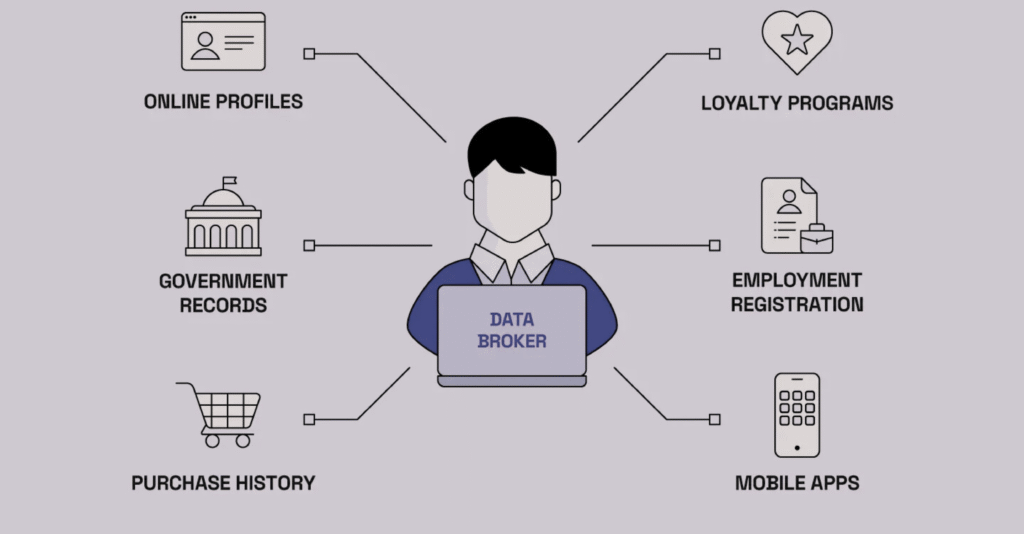
1. The data broker market will likely hit $365.70 billion by the close of 2029
The world broker market has been on a fast lane in this 21st century. Data is a precious asset in this era, especially with the emergence of the Internet of Things. As a result, the data broker market has skyrocketed in value, reaching $268.73 billion as of 2022. This will likely rise in the next couple of years to hit $365.70 billion in 2029.
2. Over twelve data points of about 60% of internet consumers are open to the public.
Data brokers collect information like age, gender, level of education, and email address. Up to 59.35% of internet patrons have at least twelve data points on public view, and up to 40.65% of internet users have 2 to 11 data points out in the open. This statistic shows that your details can be viewed without your notice.
3. Up to 62% of businesses understand the power of artificial intelligence
A lot of companies today employ artificial intelligence to streamline their operations. As many as 62% of companies know about AI-powered tools. And about a quarter (24%) of businesses use AI algorithms in sorting customers’ data.
Data Broker Market Size
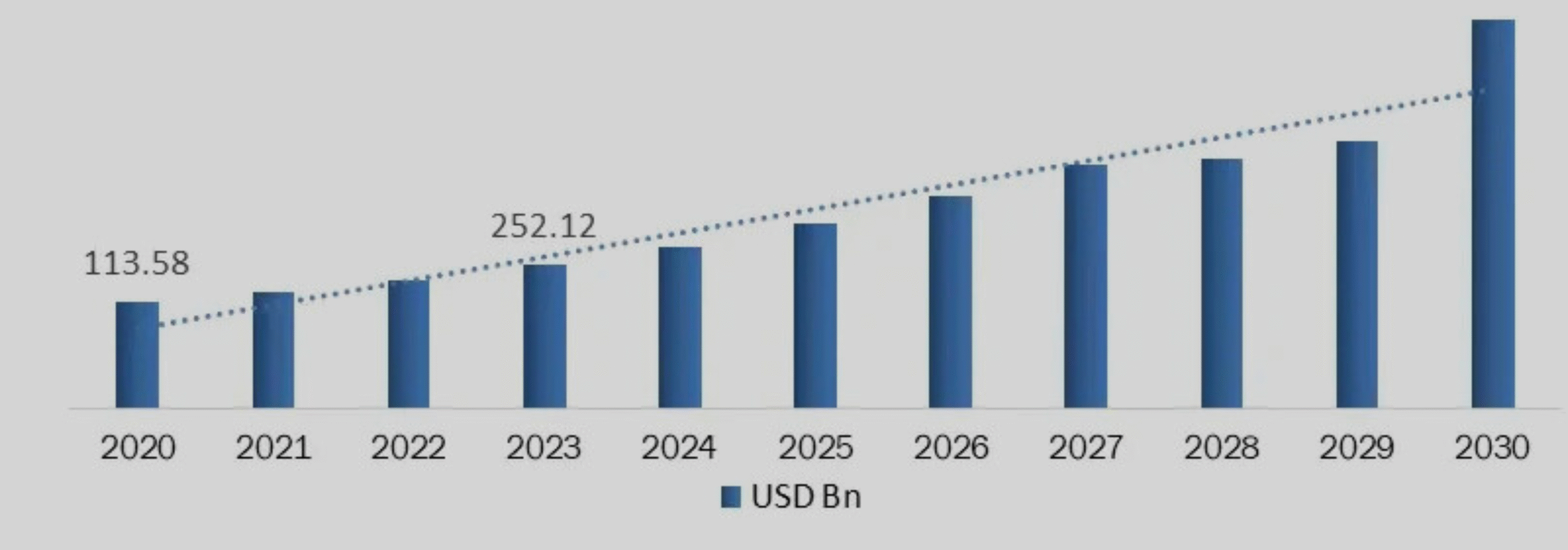
Most businesses turn to data brokers for an update on market trends when making decisions. Right below are statistics on the vast data brokerage market.
4. Acxiom is one of the 4,000 broker firms in the world.
As many as 4,000 firms are offering data broker services worldwide. Some big names in the industry are Acxiom, Epsilon, Experian, and Equifax. The high number of broker firms shows how lucrative it is.
5. One of the largest data broker firms is Acxiom, with up to 23,000 servers.
Data is readily available across all online spaces, including social media sites. Acxiom has to its credit as large as 23,000 servers. It has access to the personal data of 500 million folks worldwide. It has up to 3,000 data sets in its database for each person. Like several others in the industry, Acxiom harvests data to sell. Businesses rely on data brokers to improve their operations. Data help to increase conversion rates, retain customers, and increase purchases. The result is an overall customer experience.
6. Up to 1,400 top brands sell their consumer information.
Over 1,400 top brands are actively sharing customers’ information with data brokers. These brands get the needed information through customers’ loyalty cards. It works this way: your information in a store credit or loyalty card is sold out to brokers. The exchange provides brands access to consumers’ data. Up to 89% of clients are loyal to brands that share the same values. How wide your data is shared depends on the brand you associate with. Your information can be shared across several data collection sites.
Current Trends in Data Broker System
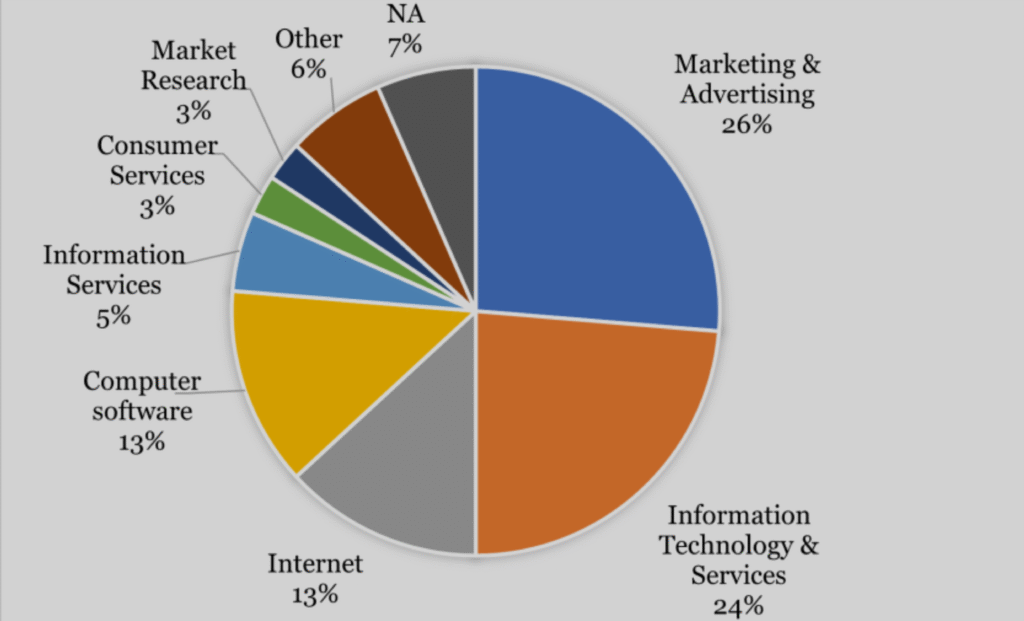
Intelligent data, big data, and business intelligent solutions have increased data brokerage firms’ revenue. A large portion of growth in the industry is as a result of the following:
- The invention of smart devices.
- High use of social media platforms.
- Much dependence on the internet.
The intelligence global market size stood at $23.1 billion as of 2020. This will likely increase in the coming months to reach $33.3 billion at the close of 2025. It shows an expectation of a CAGR of 7.6% within this period. Let’s look further into how much the data brokerage market has grown.
7. Broker firms’ revenues rose from $585 million in 2000 to over $1 billion in 2006.
The growth of data broker firms like LexisNexis and ChoicePoint is fueled by increased internet use and software programming. ChoicePoint’s sales jumped from $585 million to $1 billion in 2006, with a multimillion-dollar contract from the Department of Homeland Security. In 2004, ChoicePoint faced charges from the FTC for not disclosing a data breach, resulting in $10 million in penalties and $5 million to customers. LexisNexis acquired Seisint for $775 million in 2005 but soon faced a breach where hackers accessed 32,000 clients’ information using passwords. The success and challenges of LexisNexis and ChoicePoint highlight the viability and risks of data brokerage firms.
8. The global market for data brokerage is likely to be $407.5 billion by the end of 2028.
The data broker market was valued at $247.4 billion in 2022 and is projected to reach $407.5 billion by 2028, with an 8.67% CAGR. The COVID-19 pandemic accelerated this growth by boosting the digital economy and changing the global economic structure, opening new data access opportunities and creating new occupations.
Data Broker Risk Statistics
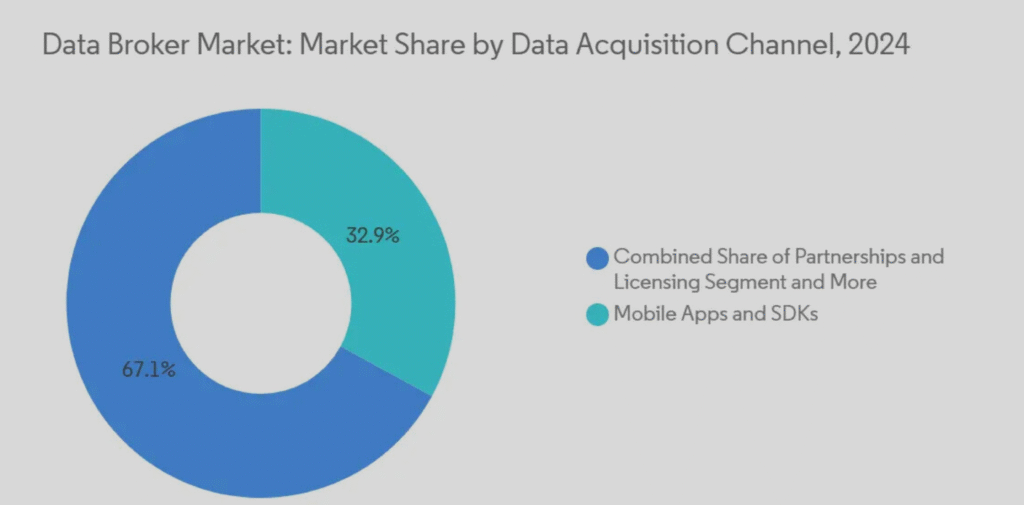
Data brokers gather people’s personal information and sell it to companies. Businesses buy data mainly for promotional and marketing purposes. These data are used to send you online ads, new deals, and marketing messages.
9. Acxiom controls the most significant part of the data broker industry
Acxiom is the first company to sell consumer information to companies for marketing purposes, claiming to have data on all U.S. households, contributing to 12% of US marketing sales. Nielsen, the next largest data broker, has operated since 1923 and collects consumer data from over 100 countries, leading in market research. Both companies excel in gathering and selling consumer information to businesses.
10. As high as 99% of business executives’ personal information is in over a dozen brokers’ sites
BlackCloak research revealed that information on top business executives is shared on over a dozen broker websites, leading to a rise in cybercrimes, which may reach $10.5 trillion by 2025. Data brokers get 70% of information on top executives from social media, and 40% can access their social accounts, putting executives at risk of cyberattacks through IP address exposure. About 95% of company executives’ profiles contain sensitive information, endangering their personal and corporate lives. The large availability of data with brokers poses significant risks, as the focus on data usefulness for business growth often overlooks the dangers to executives’ privacy.
11. Only 43% of data broker companies notify customers before using their information.
Sharing your information as a customer offers little benefit, but data brokers must seek consent first. About 43% of brokerage firms allow opting out at any time. Websites like Reputation.com enable users to control their data storage, while privacy protection can prevent data brokers from accessing your information.
Data Privacy Statistics
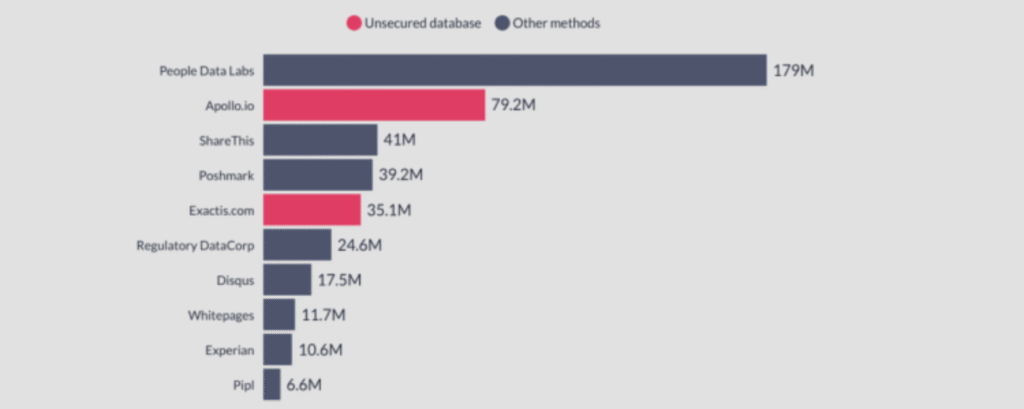
12. Up to 80% of folks want to know how their information is used.
Many people do not know how companies use their personal information. A survey conducted in 2022 revealed that people have concerns about the use of their data. Just 60% of the survey respondents said they employ tools to secure their online data. Why is there a large number of data leaks? Many people do not use privacy security tools. This is most often due to ignorance on the part of consumers.
13. About 21% of consumers believe their data protection lies in the hands of companies.
About 21% of brand customers believe businesses should protect their data, and over one-fifth oppose companies selling it, seeing it as crucial to building trust. Meanwhile, brands can sell the data of 39% of respondents as long as they inform them about its use, highlighting the importance of trust.
14. Only 43% of folks know their data can be erased.
Some laws govern how companies use, store, and process consumer data. The GDPR governs data use within European states, focusing on regulating data and granting individuals the right to erase it, known as The Right to Be Forgotten. A Surfshark survey showed that fewer than 50% of people know they can erase their online presence.
15. As high as 63% of folks are fond of deleting their browsing history and cookies.
Cookies contain data that help websites identify users, recall login details, and enhance browsing. However, using them poses privacy risks because they access sensitive information that could be sold to marketing companies and brands.
How High Has the Demand for Data Broker Services Grown?
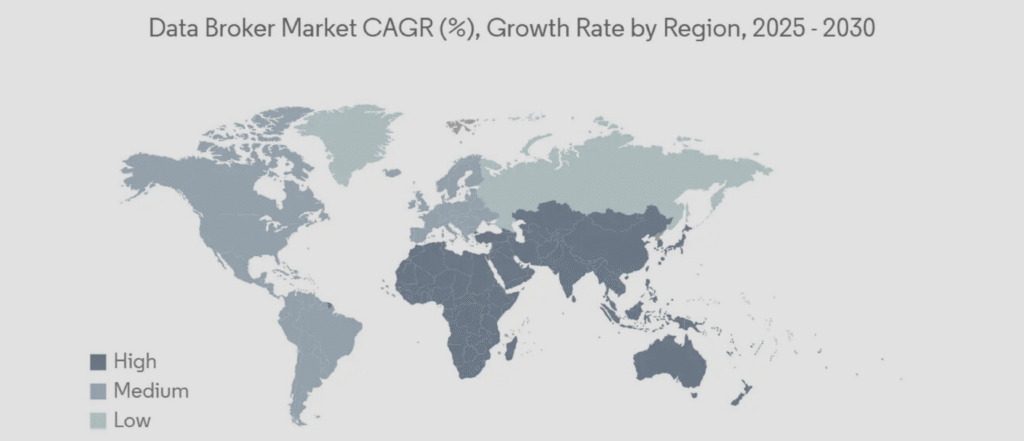
There is a high demand for data brokers all around the world. Up to about 5,000 data brokers exist in today’s modern society. Government and civil societies have rolled out about 10 million free data sites. Data protection is flexible in the United States. Data broker firms have as much as 1,500 information on each person. The reverse is the case in the EU, where data brokers are cautious about data usage. The EU maintains strict laws and GRPR restrictions on data brokers, often on the edge of the law.
In this age of innovative technology, businesses leverage consumer data for decision-making. Data analytics helps firms identify opportunities, make decisions, and improve their brand and profit. The increase in data demand has further fuelled the activities of data brokers. More businesses are looking to brokers to gain market traction. The universal data brokers market in 2023 grew to hit $230.82 billion. Data broker firms are the turning point for businesses seeking to expand their reach.
Conclusion
How well do you protect your online privacy? Data is an integral aspect of our lives today. Companies spend a lot of cash every single year on buying data, creating a wealth pool for data brokers. Companies like Acxiom, LexisNexis, and ChoicePoint are doing very well in the data brokerage industry. They can each boast of a vast store of individuals’ personal information. Social media sites like Facebook and Twitter have expanded the data collection process. Specific laws enacted by GDPR help protect user data. However, that won’t stop data brokers from collecting and trading people’s data. The data brokerage market is estimated to expand by 7.96% and reach $545.431 billion by 2028.
FAQs
Data brokers are firms or companies that gather people’s information and sell it to other companies.
Data brokers sometimes get information from your social online posts and quizzes. They also gather information from the sweepstakes you take on websites.
Experian leads the data broker industry with a consumer database of over 300 million. Acxiom fared among the top four, with over 260 million persons in its database.
Data broker firms sell people’s data to businesses for purposes such as advertising and marketing. Businesses use your data to send tailored email messages, ads, and new product offerings.
Many data broker companies crosscheck people’s information before adding it to their database. Banks sometimes turn to data brokers to get information on a client before giving out a loan.