
The growing trend in innovative technology quickly impacts almost every aspect of life, and the legal system is not left out. The virtual (remote) court, where hearings can be held anywhere, even outside the courtroom, has gradually gained traction.
The global COVID-19 pandemic spiked the popularity of virtual court, allowing the judiciary system to function remotely. Some or all participants engage in remote court hearings through video or audio devices. Moreover, the average duration of a virtual court hearing is 23.6 minutes. This article explores virtual court statistics and facts you need to know in 2025. Let’s dive in!
Key Virtual Court Statistics
Fairness In Virtual Court Statistics
1. 51% of judges admit that remote hearings provide a conducive court atmosphere similar to in-person hearings. However, they indicate concern about their potential impact on well-being and workload.
2. Public participants in virtual court hearings are more satisfied with the hearing experience than in-person users. Some highlighted benefits include reduced costs in participation, greater convenience, low anxiety due to audience, etc.
3. 93% of legal representatives are positive about virtual hearings. They confirmed the relevance of remote court hearings during the pandemic. However, there are mixed opinions about continuous of the process in the future.
4. Virtual bond amounts are 54% to 90% higher than equivalent in-person hearings.
5. According to a study on immigration courts, 50% of judges confirmed cases in which they effect changes. They had to alter credibility assessments provided during a remote hearing after conducting an in-person session.
6. Certain in-person testimonies easily deceive some juries. A study noted that a mock jury received two testimonies from children. The one in a virtual session was more accurate, while the in-person witness was inconsistent and less accurate. However, over 50% of the jury believed the in-person narration.
Zoom Court Hearing Duration Statistics
7. Pre-pandemic, 80% of participants in a study confirmed the potential of technological aid in court workload management. Notably, the innovations help court management by increasing its efficiency and productivity.
8. Due to the pandemic, almost all US courts adopted new rules allowing virtual hearings. This ensured the justice system’s continuous operation while maintaining public health guidelines.
9. A survey of 53% of judges found that they expect virtual court hearings to continue after the pandemic. This reflects a gradual shift through technological transformation in traditional legal proceedings.
10. About 19% of legal experts prefer Zoom for remote court hearings. A recent survey by a cloud-based legal tech firm, Clio, showed that some legal professionals prefer Zoom for virtual hearings. The video conferencing app suits some legal personalities for their online court sessions.
11. Michigan state court held over 100,000 hours of virtual hearings between March and October 2020. Many states recorded an increased shift to remote court hearings during the pandemic. Notably, the closure of in-person court sessions saw many adopt virtual hearings for their cases.
12. A study on the Second Judicial District Court in Reno, Nevada, revealed that Zoom usage in virtual court hearings rose to 400 sessions per month during the pandemic from 10 sessions monthly in pre-pandemic.
13. According to a UK study, virtual hearings in immigration and asylum cases during the pandemic had a median duration of 2 hours and 6 minutes, meaning half were longer and half were shorter.
14. Zoom recorded a whopping 1,270% increase in downloads between January and March 2020. The surge in the download of the teleconferencing software was during the pandemic’s peak. Notably, many businesses and court proceedings adopted remote interactions, skyrocketing the use of virtual communication tools like Zoom.
Technological & Training Challenges Statistics
15. One major challenge to virtual court is technical issues. One-fifth of public participants in a remote hearing witness technological problems. 30% of those using video tools experience technical issues, and 15% of those using audio equipment experience technical issues.
16. Dropping or freezing connections is the most reported technical issue. 16% of legal representatives, 35% of HMCTS workers, and 44% of judicial respondents reported having mainly connection-dropping during remote hearings.
17. Training is not universal among professional users. 62% of legal respondents, 42% of legal representatives, and 57% of HMCTS staff confirmed receiving training on virtual hearing participation.
18. Guidance rate for public users. 80% of public participants in virtual court hearings admit getting guidance on engaging in such sessions. However, only 87% of the respondents confirmed that it was easy to adhere to the instructions.
Communication & Location Challenges Statistics
19. Using a suitable location or environment remains challenging for most virtual court hearings. 3% of public participants admit to attending a remote hearing from another person’s home. Also, there are cases where users participated in hearings from inappropriate environments like parks, engaging on the street, driving in a motorway, using a public phone boot, and even on a plane.
20. 69% of lawyers and 62% of court staff believe virtual court hearings can relay a comparable environment to physical hearings.
21. While 51% of legal representatives agree that virtual hearings effectively create a comparable environment to in-person sessions, 37% disagree.
22. 84% of public users engaged by video and 79% of those involved by audio believed they had appropriate formal hearing sessions. Generally, a less formal environment benefits the participants in virtual court hearings. Many public users feel safer, more comfortable, and less anxious by attending a hearing from their homes.
23. Communication issues have impacted virtual court hearings over the past few years. Some legal representatives reported that it was more difficult to communicate with clients during remote hearings. Also, judging if a client is upset and controlling situations of excessive talk in virtual hearings becomes harder.
24. Using interpreters poses another common communication issue during remote hearings. 47% of legal representatives, 64% of HMCTS staff, and 70% of judicial respondents admit some difficulties with remote hearings involving interpreters. A common issue is when the interpreter or signer is not within their clients’ sight. Also, there are cases where the interpreter uses a phone to join the hearing or is not quite audible.
Virtual Court Statistics For the Future
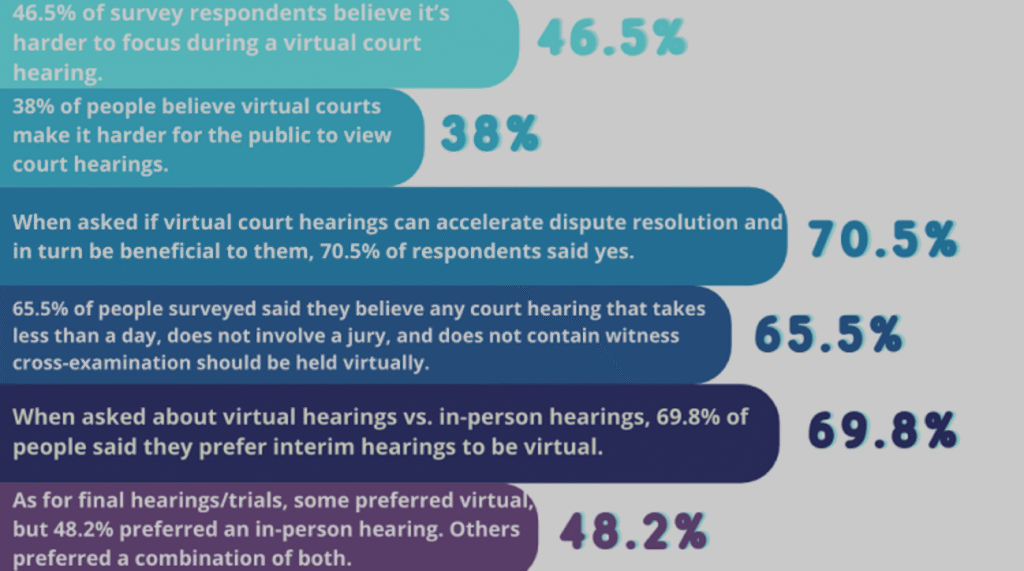
25. A survey found that 38% of people say virtual court sessions make it difficult for the public to view hearings.
26. 46.5% of survey respondents confirm that it is harder to get participants’ full concentration during a virtual court hearing.
27. 70.5% of respondents believe that remote court hearings can speed up dispute resolution and offer other benefits.
28. Of the respondents who requested virtual and in-person hearings, 10.1% preferred in-person, while 69.8% preferred remote hearings.
29. 65.5% of survey participants say that court hearings that last less than a day without a jury and witness cross-examination should be conducted virtually.
30. Regarding final hearings, 16.8% of litigants prefer virtual court sessions. However, 48.2% prefer an in-person court session.
Facts About Virtual Court Before and During the Pandemic
31. No jurisdiction consistently used remote court hearings for eviction cases before the pandemic.
32. As of November 2020, 82% of courts have permitted or engaged in virtual court hearings.
33. Michigan courts held zero (0) virtual courting hearings between April and June 2019. However, as of 2020, Michigan courts have completed over 35,000 remote court hearings, almost 200,000 hours.
34. Pre-pandemic, 37 states in the US permitted those without lawyers to use virtual court options in some cases. With time, ten more states have adopted virtual court hearings and policies for Pro se litigants.
35. Within a few weeks of the pandemic, all states in the US and the District of Columbia started using virtual court hearings. Most states also allowed litigants to file documents online.
36. Since the pandemic, courts have recorded increased and regular use of virtual courts, with over 6,000 hearings daily in California.
37. Arizona civil courts witnessed an 8% decrease in default judgments resulting from lack of appearance.
38. Ligitants’ failure to appear in court hearings constitutes the major factor for default judgments. During pre-pandemic (from 2010 to 2019), over 70% of defendants in civil cases got default judgments against them.
39. Between April and May 2020, Texas conducted 122,000 virtual court hearings. Before the pandemic, the state has never held a civil hearing through a virtual court.
40. As of November 2020, 15% of US courts prefer virtual hearings when applicable. This reflects the increased adoption of remote court hearing settings due to the pandemic.
Technology Use In the Judiciary System Statistics
41. According to a recent survey, about 72% of participants used email to submit legal documents like exhibits and hearing bundles.
42. The Second Judiciary District Court in Reno recorded a massive increase in Zoom usage for remote hearings. The usage hit 400 sessions each month during the pandemic, way higher than the 10 sessions every month before the pandemic.
43. Virtual courts brought an 8% increase in default judgments in Arizona civil courts due to non-appearance.
44. Jurisdictions influenced the possibility of conducting a virtual court hearing. However, most considerations are based on the type of hearing.
45. Most jurisdictions prefer holding criminal cases for in-person court hearings. Notably, 87% of Crown and 91% of magistrates’ courts hold mainly in-person sessions.
46. Just 86% of most family court users attend virtual court hearings.
Considerable Factors For Judges In Holding Virtual Court Hearings
Here are some factors that affect judges’ decisions in holding virtual court hearings.
47. Vulnerabilities of Involved Parties. This is the major factor that influences the placement of virtual hearings. Some of the notable vulnerable instances include physical disability, intellectual impairment, distress or fear, and others.
48. Complexity and Length of Hearing Sessions. About 64% of judges believe remote hearings last longer than in-person sessions. However, 35% say the two court hearings have the same length, while 37% think virtual hearings are shorter than equivalent in-person ones.
49. The gravity of the Case. While some cases are criminal, others could be classified as civil cases.
50. Indicated Preferences of the Public Participants. The public participants, especially the litigants, could indicate their preferred court hearing sessions.
Key Considerations For Virtual Court Hearings
51. The Virtue Court Hearing Solution is Suitable For Your Case. Several remote court hearing software solutions are available. Some hearings use teleconferencing, while others opt for fully integrated virtual solutions. Understand the type of hearing to evaluate your needs and ensure your choice is compatible with the sites from which participants will connect.
52. The Technology and Equipment Available in Each Venue. Selecting the right technology will ensure smooth virtual hearing sessions. It’s important to know the equipment other participants have access to. Key witnesses should have high-tech equipment to avoid lapses. Essential equipment includes good-quality microphones, speakers for proper sound reception, and high-resolution video-hearing cameras.
53. The Necessity of An Expert in Managing the Technology. While engaging in a virtual court hearing, you should determine if you need a tech expert to manage the technical support. Also, a tech professional would ensure that all the participants in your team have hitch-free hearing sessions.
54. The Venue and Environment of the Participants. Though everyone can connect to a virtual court hearing anywhere, not every space is suitable. Venues and environments are crucial factors that can impact the success of a virtual hearing. Here are some major factors to consider in your choice of venue:
- As much as possible, use a centralized venue for all your participants to avoid having several remote locations.
- Choose a space with less noise from road traffic, school, and office.
- Select a neutral or plain background for video conferencing.
- Increase your participants’ focus by minimizing distractions in their line of sight.
55. Run Training and Testing Sessions. It’s important to run training and testing sessions before virtual hearings to ensure the best results from participants and equipment. This helps participants understand the technical usage and identify faulty equipment, allowing for necessary changes before the hearing date.
Conclusion
The pandemic brought a drastic surge and adoption of virtual court hearings worldwide. Research in 2021 revealed that US courts conducted 72% of all criminal hearings and 76% of all civil hearings remotely. Despite the gradual shift to virtual court hearings, technical, location, communication, and training challenges persist. However, the future could be more innovation in the legal system, which will improve and change how virtual court hearings are perceived. Moreover, many judicial professionals believe that remote hearings would enhance legal accessibility and participation in the future.
Frequently Asked Questions
Virtual court proceedings provide participants with flexibility in the judicial system. Moreover, it recognizes the participants’ busy schedules and allows them to make certain adjustments. Also, it is cost and time-effective.
Technology in the legal system and court sessions improves judicial efficiency. It speeds up hearings by 50% and allows a seamless display of evidence through innovative devices during hearing sessions.
According to a 2021 report, most judges confirm the fairness and efficiency of virtual hearings. Moreover, most courts have initiated virtual civil jury trials with jurors who operate from homes.
47% of judicial respondents support using virtual court hearings. Up to 76% think that remote hearings would increase people’s access to justice in the legal system.
Technical issues remain a key challenge in virtual court hearings. 44% of judicial respondents admit facing connection-dropping during a remote hearing. Other problems include choice of location, communication issues, and training challenges for participants.