
- A dark web actor is freely distributing a dataset of over 657,000 BitMart user email addresses through a public file-hosting platform.
- Cybersecurity analysts warn that email-only datasets carry severe phishing risks in the crypto sector, where even partial data can trigger irreversible financial losses.
- Analysts rate the claim’s credibility as low to moderate, but stress that the danger to exposed users remains real regardless of where the data originally came from.
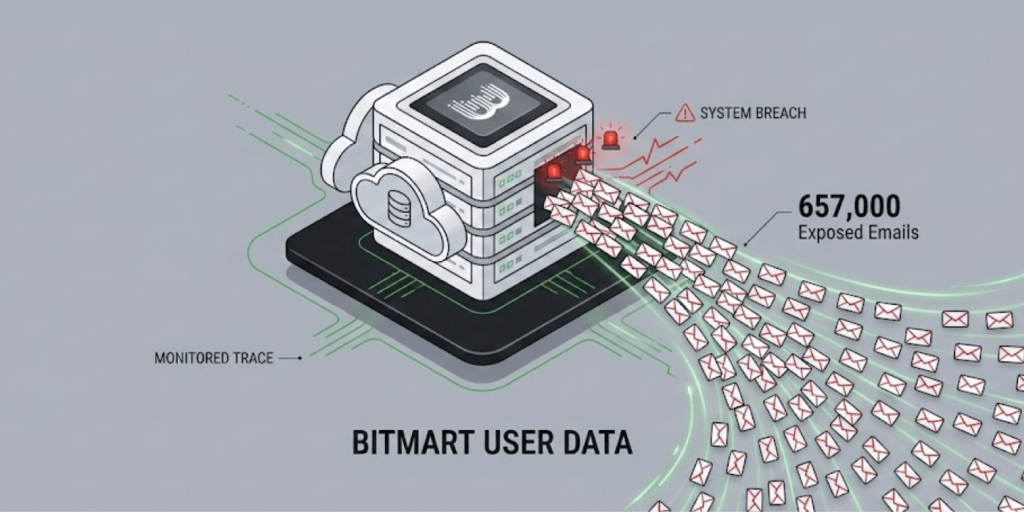
A dark web actor is freely distributing a dataset of over 657,000 email addresses allegedly belonging to users of BitMart, one of the world’s prominent cryptocurrency exchanges.
The actor is sharing the files through PixelDrain, a public file-hosting platform, placing the data within reach of virtually any malicious actor with an internet connection.
Threat intelligence monitors tracking dark web activity flagged the post, which claims the dataset carries email-only records; with no passwords or financial data visible in the sample provided.
Cybersecurity professionals are sounding the alarm. In cryptocurrency, even a standalone list of email addresses hands attackers more than enough ammunition to launch devastating campaigns against unsuspecting users.
Dark Web Actor Distributes Crypto Exchange Data for Free
The dataset, if genuine, exposes a significant portion of BitMart’s user base to targeted attacks. Armed with verified exchange user emails, cybercriminals can craft highly convincing phishing campaigns, impersonating BitMart itself, wallet providers, or fabricating urgent security alerts and KYC verification requests. These fake communications aim to harvest login credentials, private keys, or seed phrases, handing attackers direct access to victims’ crypto wallets and funds.
Analysts are blunt about the danger. One threat intelligence note accompanying the discovery puts it plainly: “In crypto, even an email list gives criminals everything they need to begin an attack,” a stark reminder that cryptocurrency-related data breaches carry uniquely high stakes compared to other sectors, given that blockchain transactions are irreversible once executed.
The choice of PixelDrain as a distribution channel amplifies the threat considerably. Unlike restricted dark web marketplaces that demand registration or cryptocurrency payment, public file-hosting platforms allow any bad actor with an internet connection to download and weaponize the data immediately; no credentials required.
Analysts Flag Low Credibility but Warn Danger Persists
Threat intelligence analysts have rated the claim’s credibility as low to moderate. The posting actor carries minimal reputation on dark web forums, and no structural proof or independently verifiable sample exists to confirm that the dataset is both authentic and freshly sourced directly from BitMart’s systems.
The most probable explanation, analysts say, is that this is a repackaged or previously leaked collection; a common tactic where bad actors re-release old breach data under a fresh narrative to generate notoriety or power new attack waves.
But regardless of origin, the risk implications for every individual whose email appears in the dataset remain the same. Attackers holding a verified list of crypto exchange users can immediately launch phishing operations, harvest credentials through fake exchange communications, and run social engineering attempts designed to drain wallets clean.
Freely distributed datasets like this one benefit small and mid-level threat actors most. Obtaining high-quality stolen data once required significant resources and dark web credibility. Free public distributions now eliminate that barrier entirely.
BitMart Users Must Act Now
Cybersecurity experts are urging BitMart users to treat every unsolicited email from the exchange (or any affiliated service) with extreme suspicion. No legitimate cryptocurrency platform sends unsolicited requests for passwords, private keys, seed phrases, or KYC documents through email links.
Experts are advising users to activate two-factor authentication on their accounts immediately. Maintaining a dedicated email address exclusively for exchange registrations adds a valuable layer of separation. Users must also verify every communication through BitMart’s official website or app before clicking anything or taking any action.
BitMart has not issued a public statement regarding the alleged leak at the time of publication. Analysts have assessed the incident’s overall risk status as moderate; a rating driven primarily by the cryptocurrency context, where even partial user data in the wrong hands can produce direct and irreversible financial losses. In crypto, the distance between a warning and a disaster is often just one convincing email.